
Creative Nonfiction
Motivation and Reconciliation
At fourteen years old I was scattered, lost in the lonely reality in which I felt there was no place where I belonged. I defined myself by comparison with others. Part of this view of comparison stemmed from my family relationship with my older brother.
As with most older children, he had a more responsible character, and coupled with a trait of perfectionism, he worked to accomplish many things in his life. It was always said in my family that we were polar opposites, with my contrasting mentality of contentment and go-with-the-flow personality. One particular point of comparison would be that for years I would see my brother go on missions trips and be impacted by his time there, while I was too young to participate. That initial comparison is what brought me to Guatemala and Belize on a mission trip.
The sky is blue, the taste of coffee is gross, and Jesus is real and died for your sins
At the time, I chose to not register the reason why one went on a mission trip, and instead focused on the act of going on the trip itself. My motivations were not the same, and at the core I didn’t understand anything but the surface reasons of why someone goes on a mission trip. Reasons such as encountering new cultures, helping those in need, and experiencing a new adventure were put on the forefront of my mind, while spreading the news about Jesus was just a good add on. At the heart I didn’t have the right motivation because I didn’t know the God that gave the motivation.
The knowledge of Jesus Christ was so attached to my reality that it just fit in the list of everyday facts: The sky is blue, the taste of coffee is gross, and Jesus is real and died for your sins. At the time I acted like this knowledge was just something that brought peace of mind to someone and that was the encapsulation of the effect of Jesus in people’s lives. I didn’t understand what having Jesus in your life could really mean because at that point, I only knew about the man from Galilee, I didn’t have a deep connection with Him. I didn’t realize that the knowledge of Jesus wasn’t supposed to just add onto your life, it was supposed to shift your very perception of what life is. It says in 2nd Corinthians 5:20 that,
“We are therefore Christ’s ambassadors, as though God were making his appeal through us. We implore you on Christ’s behalf: Be reconciled to God.”
Reconciliation is the core of every mission movement. How this is attained is through Jesus’s love being shown through the actions of those He sent. The more the person of Christ knows and encounters the love of God, the more that same love is reflected in their eyes, actions, and heart. The magnitude of Jesus’s love in its very nature is shown through overflow.
RECONCI’LE, verb transitive
[From its Latin roots-The literal sense is to call back into union.]
1. To conciliate anew; to call back into union and friendship the
affections which have been alienated; to restore to friendship
or favor after estrangement.
True reconcilement means encountering love.
We were always meant to have a restored relationship with God, always meant to have this feeling of complete wholeness in ourselves, with nothing missing and everything gained. When that happens, it also brings the motivation to become the median who introduces the love and life that can be gained from a deep relationship with Christ.
At fourteen years old I didn’t realize that knowledge of Christ is not the same as reconciliation to Christ. But one of the great things I’ve learned about God? He switches the narrative, using the weakest motivations to move someone to make an impact and in the process cover and reshape their own motivation with His.
Esperanza: The Impact of Hope.
Everyone has different flashes of memory that proceed the word of hope. My own memories take shape in moments of inspiration, support and direction. However, the first time I was an instrument in giving someone hope, it changed my perspective of how much one word can hold an impact on someone’s life. What can having hope mean to them? To me?
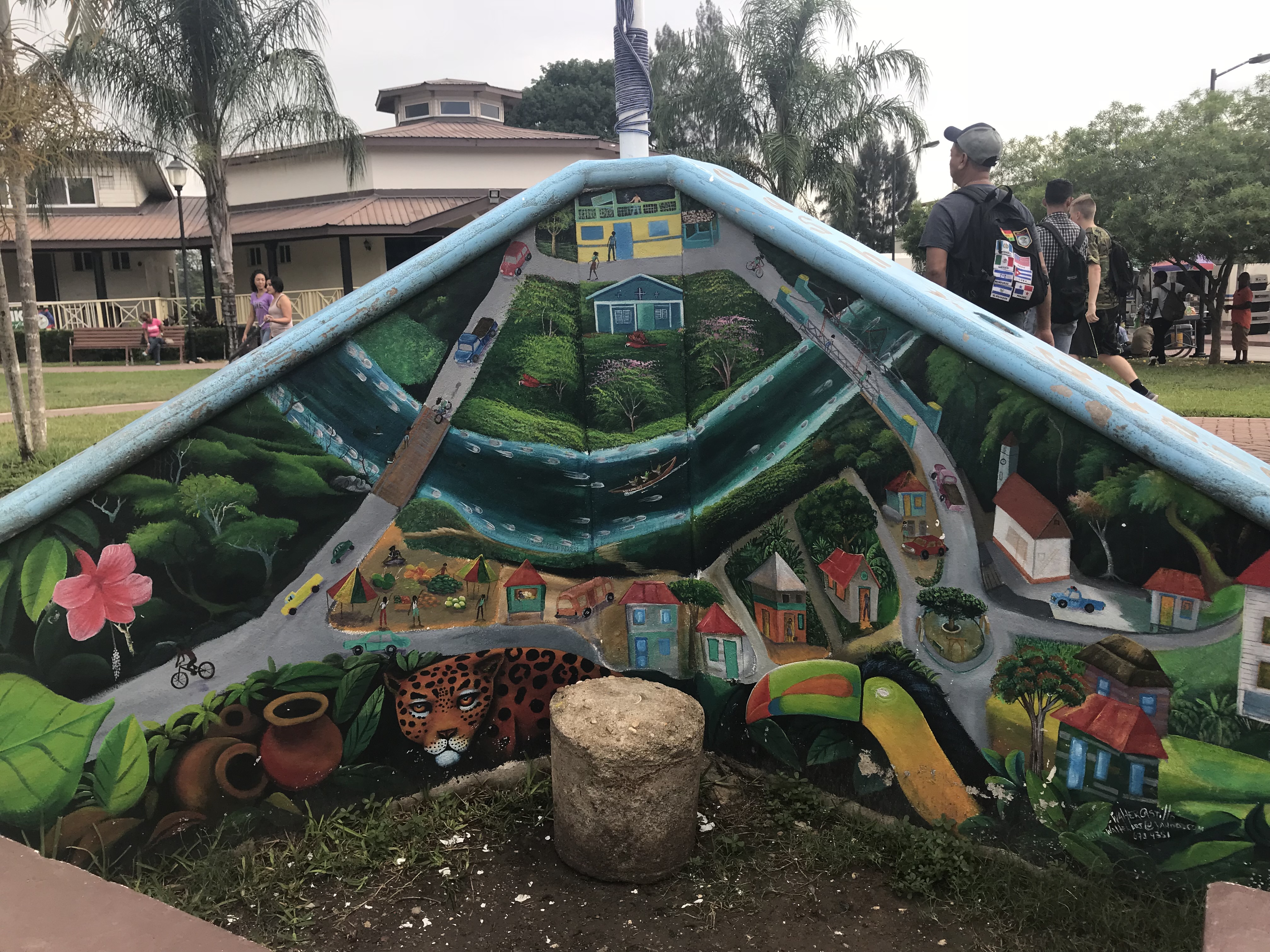
Belize itself was a vibrant kaleidoscope of nature. I remember thinking that I had never seen so many shades of green in my life. In the duration of our two week trip, we mainly stayed at our home base in Belize with day trips to Guatemala for 3 days. The heart of the ministry was to serve the community through needed projects, as well as perform a short skit with narration and music that focused on the story of the Toymaker and Son, an allegory for Jesus’s life, death and resurrection.
The play, built with outside narration and silent players, started out with one character- A Toymaker who then is joined with his Son; together they carefully craft their first two dolls, a prince and princess. Reflecting on this scene I know now this attention to detail in their creation is a visual representation of a passage in Psalms 139.
“You know me inside and out, you know every bone in my body:
you know exactly how I was made, bit by bit, how I was sculpted from nothing into something.”
This pure connection between creator and creation is broken however by the machinations of the Evil Magician, who introduces evil and corruption into the world of the characters. As more characters enter the story they are influenced by anger and meanness. However, The Evil Magician isn’t satisfied by just introducing evil, he wants to continue to torment the characters, creating a band of tigers to terrorize others, making the lives of characters such as the soldier, ballerina, and clown miserable. Right when all seem to be lost in a torrent of their torment and pain, the Toymaker’s son appears. He brings with him the original intentions of their design and reminds them of the love in which they were created. This brings great joy and hope to the toys. But because of His message of hope, the magician employs his tigers to violently attack the Son, resulting in His brutal death. After this, all of the toys are once again confronted with the reality of darkness and mourn their crushed hope. But the story isn’t over, miraculously, the Son is resurrected and joins the fight against The Evil Magician, ultimately triumphing over his adversary. The play concludes with the Toymaker’s son bringing back the toymaker, and a hug between all of the characters with the Toymaker’s son at the center, representing the restoration of relationship with Christ.
The part that I held in the play was a mime in a set of two that symbolized the gate into the garden that the Evil Magician would enter into. In this character I was present on stage the entire play, giving me a clear vantage point of witnessing the story. The more times that I witnessed the play, the more the story started to penetrate into the comfortability of my understanding of the Gospel. Through interaction with the play I was able to see a physical representation of the loss that I recognized in myself, as well as a symbolization of love and the way that it gave hope, impacting and changing the reality of the characters. In being a part of the play, I started to see the beauty of what reconciliation with Christ could really mean. I was also able to see the response it brought out of others. Those who originally had only stopped for a moment out of curiosity, were then drawn to stay and watch the rest of the play, bringing touching moments to all those involved. One particular moment that marked me was when we visited Guatemala for a day and performed at a highschool in the heart of the city.
It was the third time that we had performed the skit and the weather was sweltering. Sweat plastered my hair to my forehead and poured down my back as I stood as the gate. At the moment it was uncomfortable and exhausting. But then I saw the reactions of the students during the play. I saw their rapt attention focusing on the significant moments. The booing at the acts of the Evil Magician, the sadness over the brutal treatment of the Toymaker’s Son, the joy when the son came back to life, the breaths held during the fight between the Evil Magician and Toymaker’s son, and finally the cheers when the Toymaker’s son won.
Through their eyes I was able to see the impact that this story had on them.
Afterward as most of the cast dispersed and talked to the various students that surrounded the area, my eye gravitated to one girl at the back who was talking with one of her friends; Grabbing a translator I went to talk to her. When I approached, the girl’s eyes first widened in surprise and then turned downward in reservedness, but as I asked her questions about what she thought of the play and she responded, her body started to relax, and her eye contact with me increased. She had liked the play, and I learned that she recognized the story as the Gospel about halfway through the play. As our conversation continued I noticed that the girl carried herself as if she was weighed down by something. She talked animatedly but I felt like there was something underneath the surface that was bothering her. I asked if I could pray for her, and if she had anything weighing heavily on her heart. She answered that she was filled with uncertainty and didn’t feel like she and her family had a place to go to find sanctuary from the struggles of their life. I encouraged her and was able to show her compassion for her situation, inviting her to join the church community that my ministry had connected to while in the city. When I started to pray for her, she broke down in tears. But as I continued, I started to see a transformation in front of my eyes. When I ended the prayer a small smile was present, her eyes glistening with those same tears that a moment before were products of hurt and now were full of gratefulness.
I could see the hope that had been placed inside of her. All from one moment where she felt seen and heard. It was at this moment that I started to see the intentional love of God shift my perceptions and priorities and replace my insecurities with his motivating purpose.
A Life of Service
Growing up, I learned from my parents that service is the center of Christianity. It is in the very fabric of the religion, with every action that Jesus did in the New Testament stemming from a desire to love people through service. In Christianity, this attribute of Jesus is summarized by the statement of having a servant’s heart. This is defined by a few key characteristics: Joy is present in the act of serving others, regardless of what it might cost or what task is asked of them, big or small; There is no expectation for the service to be repaid,; and a motivation rooted in being a willing servant of Christ, with all credit of love and care belonging to God, who directs the opportunity to serve. The perfect example of this is in Philippians 2: 7-8 NLT
“He gave up his divine privileges; he took the humble position of a slave and was born as a human being. When he appeared in human form. he humbled himself in obedience to God and died a criminal’s death on a cross.”
This is the exemplified servant’s heart. After choosing to follow Jesus at fourteen, I began to finally understand my observations of those around me in which the more they pursued learning about Jesus, the more there was a shift in their priorities and actions.
When I was sixteen years old I was experiencing this shift and it propelled me to go on a mission trip to Romania and Hungary.
Encountering Romania was like encountering hospitality, the people we met were joy-filled and caring. However if one looked closely, shadows of great suffering were visible, with scars of communism found in abandoned brick buildings and dilapidated sectors.
Similar to my first trip, we performed a short drama. However it was more in the style of an 80’s flashmob than a full performance. Our costumes drew people’s attention more than anything else, with shoulder pads of our jackets as high as our chins, and bulky sunglasses paired with white face makeup.
The moment in which I felt like the biggest impact contributed by our group, was the day that we reserved to serve this one orphanage in the countryside of Romania. It was there that I finally understood the gravity of serving.
We were greeted with the smiles of children and a building with a burned and broken roof. A couple months prior a fire broke out in one of their buildings and the tiles of the roof became charred and unusable. However they didn’t have the manpower to first remove the tiles of the long building as well as replace them. That is where we came in. The heart of serving is when you see a need, there is motivation to fill that need, and the group I was with was defined by their determination to provide what was needed in that moment. We started early in the morning, first forming a human chain to remove the burned tiles off of the roof and after that was accomplished to then carry new tiles up the human ladder and install them. In all honesty, it was backbreaking work. Each tile was around 10 pounds, and after hours of carrying multiple at a time and the repetition of lifting them, even the most fit of our group had arms of jelly. Yet the spirit of the group was the most supportive and joyful than I had ever encountered. There was a determination that stemmed from a desire to help that propelled us forward beyond our own strength and capacity. I still remember the crystal image of the smiling faces of the children as their building was remade in front of their eyes. After the work was done, we were able to interact and play with the children. They were so curious! Asking us questions about our lives, faith and whether or not we could beat them at soccer. It was at that moment that I understood. From the clinging embraces of children wanting us to stay when we had to leave, to the smiles and laughter of our interactions, I understood why serving was a priority.
“Real religion, the kind that passes muster before God the Father, is this: Reach out to the homeless and loveless in their plight, and guard against corruption from the godless world.” -James 1:27 MSG
So many times as humans we overcomplicate something that was supposed to be simple. One of the highest commandments that Jesus gave was to love one another. It is through this heart of serving that has propelled philanthropy. That is why it can be seen throughout history the impact that Chistians have made in helping others. My eyes were now open to the impact that christians have contributed to history.
The concept of a hospital was created in the 4th century AD by Christianized Romans who opened homes to heal the sick and needy (Lienhard, Engines of Ingenuity) and today 1 out of 5 individuals in the U.S are cared for in a religious-based hospital (Zinmeister, Less God, Less Giving?). Christian organizations are also found to be in the forefront in offering programs from helping those that are addicted to those that are unemployed, as well as providing 44 billion dollars (this is just from the US) to help the poor and needy overseas. But money isn’t just donated, time and effort is as well. With Christians shown to be more willing to provide service and medical support to impoverished or hard-to-reach people groups in which “governments and international bureaucracies have no effective reach” (Zinmeister, Less God, Less Giving?).
Actions speak louder than words. On that trip to Romania I learned that I wanted to mirror the God that was willing to wash a person’s feet in service and ready to sacrifice his body daily to provide to those in need. I wanted to care for others the way that I had been cared for by Jesus.
A life of service is a pursuit of love.
Citations-
“Access Your Bible from Anywhere.” BibleGateway.Com: A Searchable Online Bible in over 150 Versions and 50 Languages., http://www.biblegateway.com/. Accessed 13 Nov. 2024.
“Invention of the Hospital.” The Engines of Our Ingenuity, engines.egr.uh.edu/episode/991#:~:text=Hospitals%20were%20a%20very%20altruistic,or%20hospices%2C%20were%20highly%20specialized. Accessed 13 Nov. 2024.
Zinsmeister, Karl. “Less God, Less Giving?” Philanthropy Roundtable, 27 Feb. 2024, http://www.philanthropyroundtable.org/magazine/less-god-less-giving/. Accessed 13 Nov. 2024.
Leave a Reply